
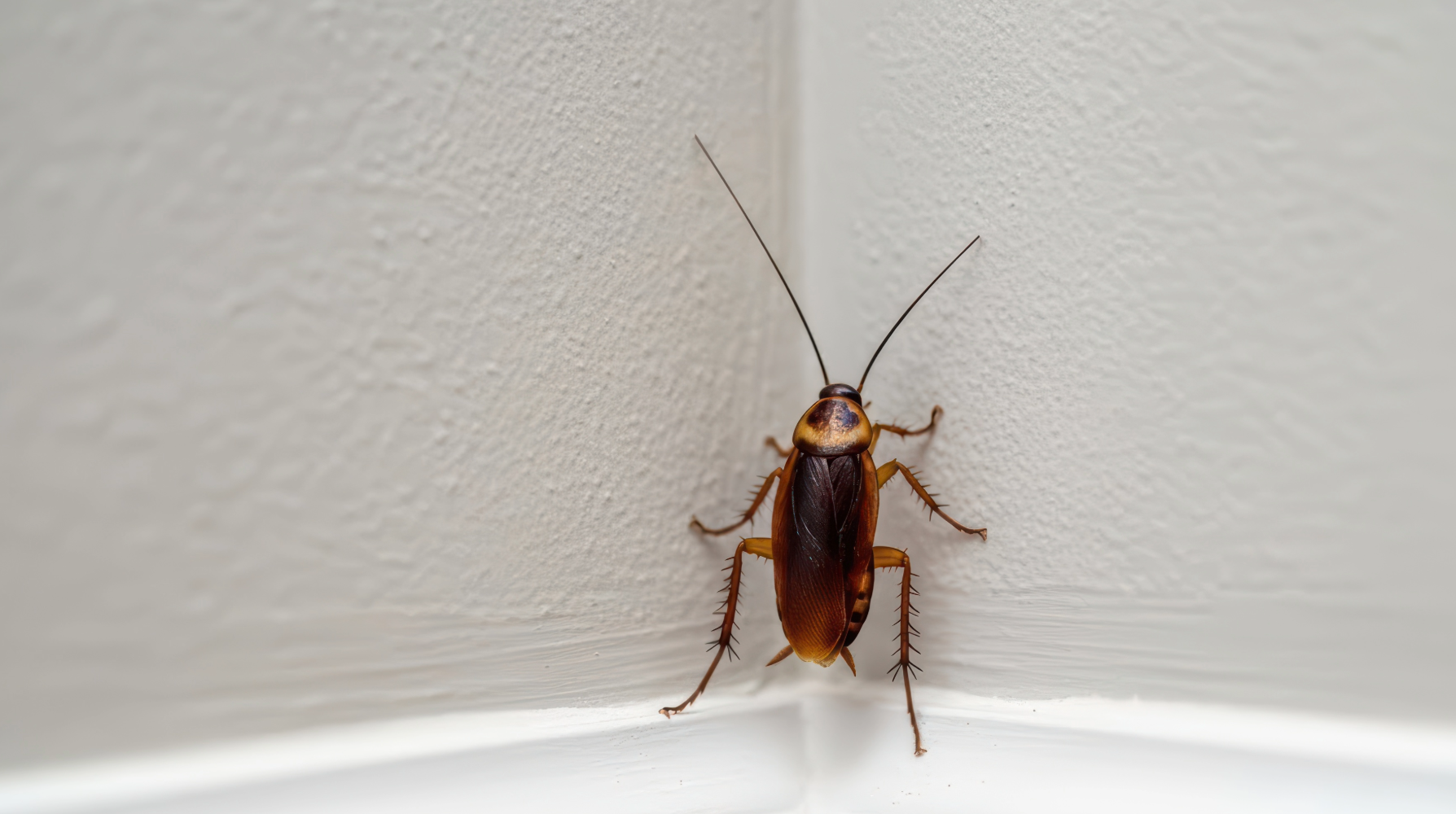
Yes, cockroaches can climb walls, and many species are surprisingly good at it. They can move up vertical surfaces, across ceilings, and into cabinets, shelves, and other elevated areas of your home.
Their climbing ability comes from specialized structures on their feet rather than simple “sticky feet.” Cockroaches use a combination of claws, friction, and specialized adhesive pads to maintain traction as they move across different surfaces.
How Do Cockroaches Climb Walls?
Cockroaches have several structures on their feet that help them grip surfaces. Their claws can catch on microscopic irregularities, while specialized pads called euplantulae and arolia help create friction and adhesion.
Researchers have found that these foot pads contain microscopic structures that interact with the surface beneath them. In other words, a wall that looks completely smooth to us can provide plenty of microscopic texture for a cockroach to grip.
Their six legs also work together to keep their body in contact with the surface. Different parts of the foot help provide traction depending on whether a leg is pushing against the wall or pulling the cockroach forward.
This combination gives cockroaches the ability to move vertically without simply relying on suction or a sticky substance.
How Fast Can a Cockroach Climb?
Cockroaches don’t just climb walls. They can climb them quickly.
In one study, researchers measured the climbing ability of the death’s-head cockroach (Blaberus discoidalis) and recorded vertical climbing speeds of approximately 19.5 centimeters per second. That’s roughly five body lengths per second. In comparison, a cockroach on flat ground can move at speeds of up to 150 centimeters per second or 3.4 mph.
The researchers also observed that cockroaches use a coordinated movement of their legs while climbing. Their ability to quickly adjust how their feet interact with a surface helps them maintain traction while moving vertically.
So if you see a cockroach disappear up a wall, it isn’t moving slowly or struggling to stay attached. Climbing is a normal part of its movement.
Can Cockroaches Climb Smooth Walls?
This is where the answer gets a little more complicated.
Cockroaches don’t necessarily need a visibly rough surface to climb. What looks smooth to the human eye can still contain microscopic irregularities that their feet can use for traction.
Research examining cockroach foot pads found that surface texture affects how the pads interact with a surface. The size and spacing of microscopic features can influence how much contact the cockroach’s foot makes with the surface.
That means there isn’t a simple rule that cockroaches can climb rough walls but cannot climb smooth ones. Their ability depends on the specific characteristics of both the cockroach’s feet and the surface.
Can Cockroaches Climb to the Ceiling?
Yes. A cockroach that can climb a wall can potentially make its way onto a ceiling.
Their specialized foot structures allow them to maintain contact with a surface as they move vertically and transition onto horizontal surfaces. This is one reason cockroaches can sometimes turn up in places homeowners don’t expect, including upper cabinets, shelves, light fixtures, and ceilings.
Cockroaches may climb because they are searching for food, water, shelter, or a route to another part of the building.
What Does It Mean If You See a Cockroach on Your Wall?
Finding a cockroach on the wall doesn’t necessarily mean there is a large infestation, but repeated sightings deserve attention. Cockroaches often hide during the day and become more active at night, so seeing them regularly can indicate that they have found favorable conditions inside your home.
Look for potential sources of food and moisture around sinks, appliances, cabinets, plumbing connections, and other dark areas. Cracks and gaps around pipes, doors, windows, and the foundation can also provide entry points.
If you’re finding cockroaches throughout your home, treating the individual insects you see usually won’t solve the underlying problem. A professional pest control inspection can identify where cockroaches are entering, where they are hiding, and what is attracting them to the property.
Contact ELDER Pest Control for Cockroach Treatments
If you have a home or business in South Jersey and are seeing cockroaches, our team is ready to not only eliminate your cockroach infestation, but prevent them from coming back in the future. Contact us today to schedule your inspection.
Sources
- National Library of Medicine: Vertical climbing in cockroaches
- National Library of Medicine: Cockroach foot adhesion and friction
- National Library of Medicine: Frictional interactions of cockroach foot pads
- National Library of Medicine: Surface texture and cockroach foot-pad attachment
- Dynamics of Rapid Vertical Climbing in Cockroaches